My research interests include: all things tectonics (of course!), structural geology, petrology, and geochronology. My research integrates field observations and mapping with a variety of analytical techniques.
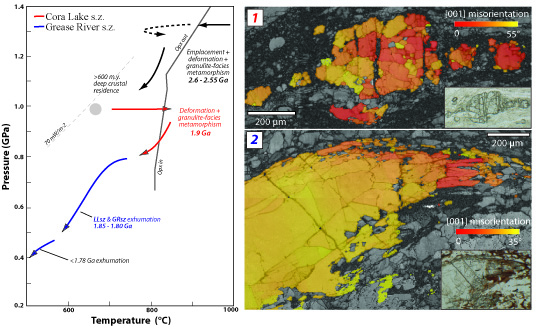
My M.S. thesis research focused on characterizing the deformation behavior and histories of ancient deep crustal shear zones in the western Canadian Shield (Northern Saskatchewan).
I wanted to know the processes and factors that influence the strength of continental crust... To what extent does composition, fluid, temperature, and/or pressure influence the strength of the crust??
I investigated the contrasting deformation behavior of SILLIMANITE, a common mineral in felsic continental crust, in two different settings:
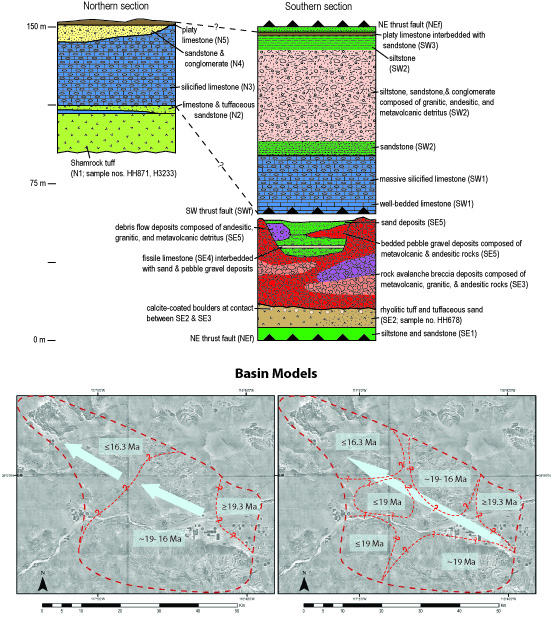
While at the USGS, I was lucky to partake in several different research projects. Highlighted here is my most recent research at the USGS which focused on the stratigraphy, age, and depositional environment of Neogene sedimentary and volcanic strata in the Mojave Desert (S. California). Deciphering a complex structural history in this region at the intersection of two roughly orthogonal faults allowed me to infer different models for Miocene basin evolution. These results also have important broader implications for Eastern California shear zone Neogene tectonics.
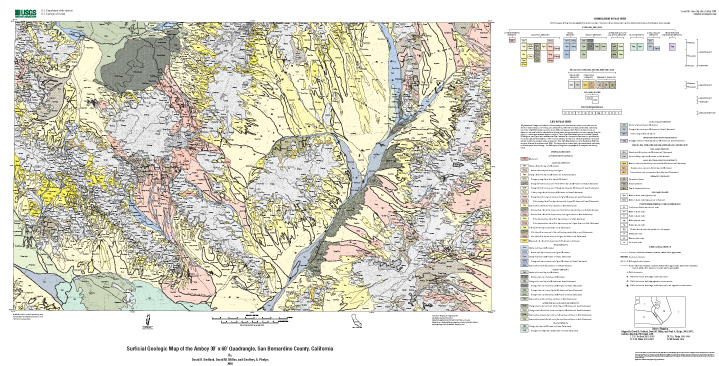
I managed several ArcGIS geodatabases and developed printable maps based on cartographic standards for a series of 1:100,000-scale surficial geologic maps in the Mojave Desert (example below).
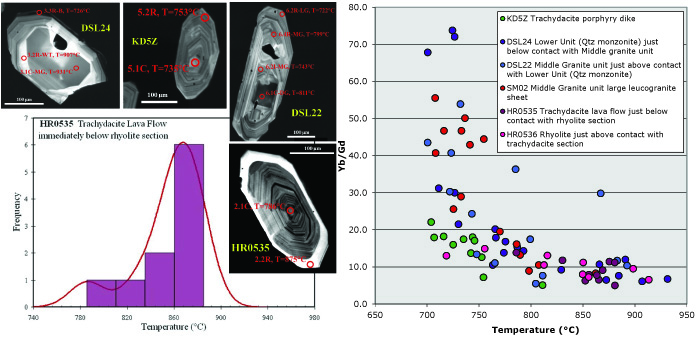
My undergraduate senior project research focused on using zircon geochemistry and Ti-in-zircon geothermometry to deduce a thermal and chemical evolution of zircon grains in the Miocene Searchlight magmatic system (Colorado River Extensional Corridor, S. Nevada). Results suggest low-temperature fractionation and recycling of zircon grains during solidification of the pluton and a late episode of thermal rejuvenation of the magma chamber coincident with the onset of eruption.